The ShredDead skill tree
Reading the ShredDead skill tree: what the hex nodes buy, how slots and levels differ, which branches to open first and how to stop the camera fighting you.
The skill tree is the game. Everything else — the shooting, the loot, the hordes — is the income stream that feeds it. 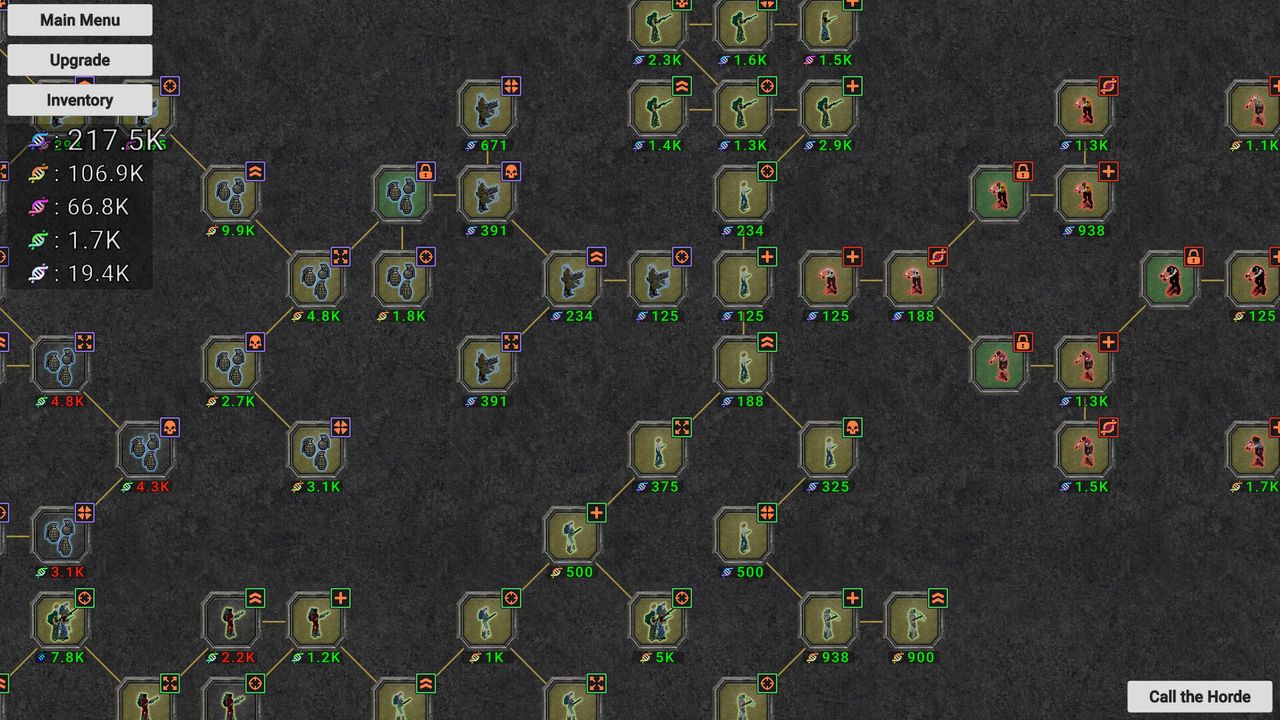
How the tree is built
Nodes are hexagonal icons joined by lines, laid out on a graph you pan and zoom. Each node has a DNA price shown next to it, and each node can be upgraded more than once. Unlocking a node opens it; upgrading a node is what produces the actual numbers. Steam tracks those separately: Full Skill Tree (unlock all slots) sits at 23.7%, Mastery (fully upgrade all skills) sits at 18.5%.
That 5.2-point gap is the single most useful number on this page. Thousands of players opened the whole tree and never finished it, because unlocking is cheap and upgrading is not.
Slots versus levels
| Action | What it costs | What it gives |
|---|---|---|
| Unlock a slot | A single payment in one DNA colour | Access to the node's upgrades |
| Upgrade a level | Repeat payments, scaling with level | The damage, rate or capacity you actually wanted |
| Unlock a second branch | A different DNA colour | A parallel lane, not a stronger one |
The practical rule: do not open a third branch until the first two are at a level you can feel. A tree that is wide and shallow loses to a tree that is narrow and deep every time, because enemies scale on total health, not on how many nodes you own.
Which branch first
There is no official published node list, so this is the order that matches how the numbers behave in practice:
- Main gun damage. It fires without input, so every point works while you are in menus.
- Fire rate on the same gun. Damage and rate multiply each other.
- One defender's damage. A second kill zone beats a stronger single zone once waves stack.
- Anything that raises DNA income. Compounding beats a flat bump.
- Utility nodes. Slower, later, and only after the first four.
The DNA and costs page explains which colour gates which band of the tree and why yellow becomes the wall.
The camera problem
Zooming in snaps the view to the centre of the tree, which can put lower nodes off-screen with no way to reach them. Zoom out with the mouse wheel and the whole graph comes back. It is a real annoyance — one player posted a screenshot of unreachable nodes — and it is covered with the other launch-week problems on known issues.
Reading the prices
Prices are paid in one of five DNA colours. Early nodes want blue, mid nodes want yellow and green, late nodes want purple and white. Because blue arrives faster than the tree can spend it, the mistake at the start is hoarding blue; the mistake at the end is treating yellow like blue. The economy breakdown lives on DNA tiers and costs.
Respec and reset
There is no free respec inside a run, but prestige resets the tree and returns points. That is the only undo the game offers, which is why the prestige page is worth reading before you commit to a branch you regret.